Something that pulses
CLOCK taps the transport. CHAOS free-runs with no transport at all, and FOLLOW takes its time from live audio — a microphone, or a file.
CLOCKCHAOSFOLLOW
Modular synthesizer · in a browser tab
You do not perform on this and you do not program a timeline. You wire up something that pulses, connect it to something that decides what happens, run that into something that makes sound — and leave it going.
Open the synthesizer Read the guide
Free · nothing to install · no account · every sound synthesized on your machine
How a system is built
Every patch here is the same shape. Something keeps time, something turns that time into rhythm and melody, and something turns that into sound. Swap any layer for a different module and the piece changes character without being rewritten.
CLOCK taps the transport. CHAOS free-runs with no transport at all, and FOLLOW takes its time from live audio — a microphone, or a file.
CLOCKCHAOSFOLLOW
These turn one pulse into rhythm, melody and density: a shift register that mutates, Euclidean rhythms, chance gates, a falling ball. Or write the part yourself on a grid.
TURINGEUCLIDBLOOMGRAVITYGRID
Oscillators, a ladder filter, modal resonators, a Benjolin, eight drum voices — then CONDUCTOR on top, working at the scale of the whole piece.
VCOMODALBENJOLINDRUMSTAPE
The rack
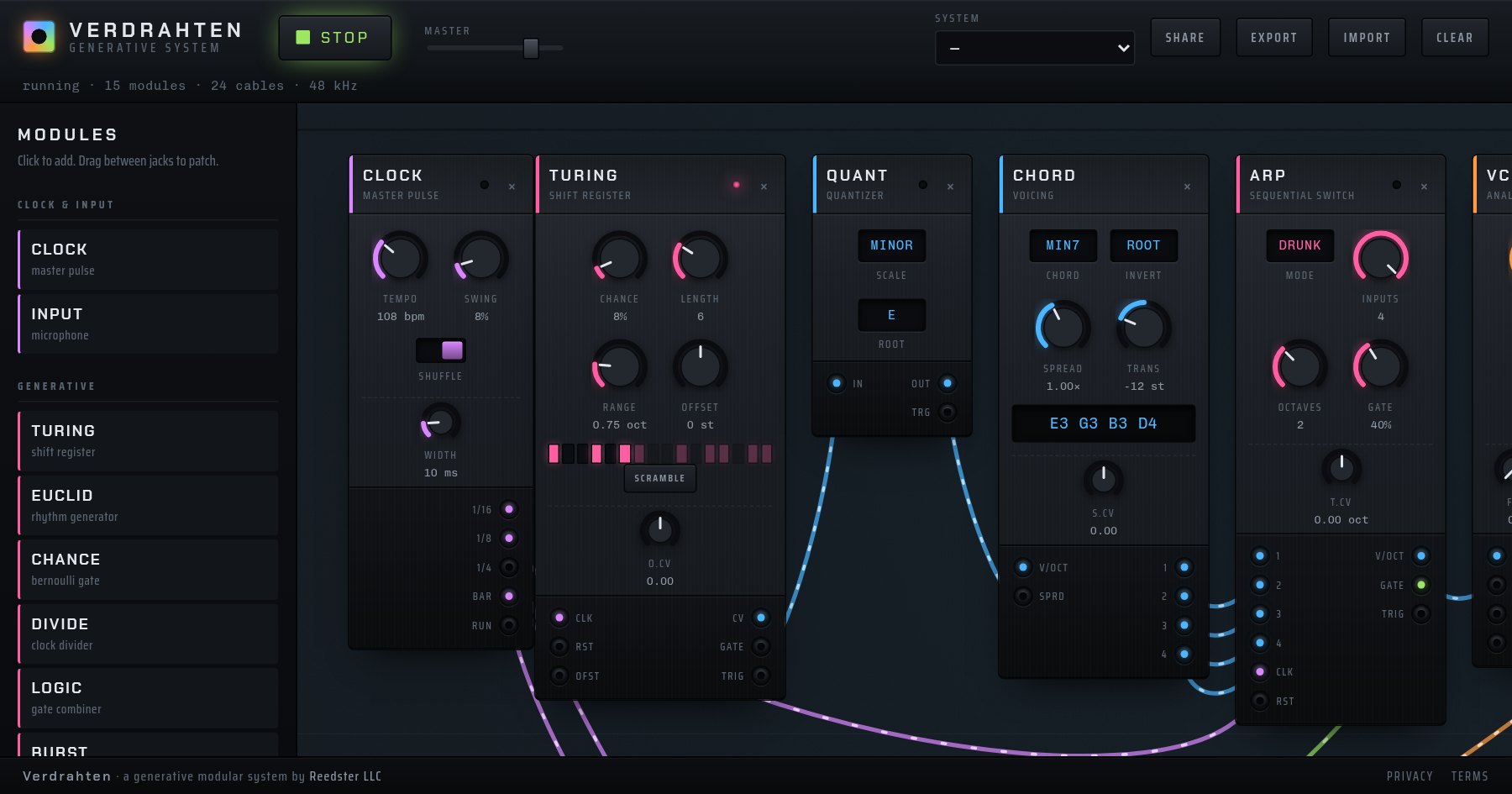
Pick one from the SYSTEM menu, press RUN, and leave it alone. Every one of them runs indefinitely without repeating exactly. Pull a cable out and it is yours.
What else it does
Open a room and hand out the link. Everyone sees the same modules, cables and knob movements, and each machine renders the audio itself. Put a microphone on the air and it travels browser to browser.
SHARE packs the whole system into the URL — about 300 characters for a fifteen-module patch. Nothing is uploaded and no copy is kept.
Record, overdub, and play back at any speed or in reverse. Its output patches back into the rack, so the tape can become part of the system.
A session recorder writes the master output to a WAV file, exactly as you hear it, whenever something is worth keeping.
Every sound is synthesized in the page. The parts that need per-sample logic run on the audio thread in AudioWorklets; the rest is native Web Audio.
No account, no sign-up and no cookies. Your rack is saved in your own browser, and you can empty it whenever you like.
Questions
Verdrahten is a free modular synthesizer that runs in a web browser. Instead of playing it like an instrument, you patch cables between modules that pulse, modules that decide and modules that make sound, then leave the system running. It is aimed at generative music: patches that play themselves.
It is free and there is no account, no sign-up and no cookies. Your rack is saved in your browser's local storage, so it is still there when you come back.
No. It runs in a current version of Chrome, Edge, Firefox or Safari and needs only JavaScript and the Web Audio API. All sound is synthesized in the page, on your own machine.
Yes. Pressing ROOM opens a shared rack and gives you a link to hand out. Everyone sees the same modules, cables and knob movements, along with each other's pointers, and each person renders the audio on their own machine. An INPUT panel can also put a live microphone on the air to the rest of the room, browser to browser.
SHARE packs the whole system into the URL itself and copies it to the clipboard. A fifteen-module patch comes to roughly 300 characters. The patch travels in the part of the link after the #, which browsers never send to a server, so nothing is uploaded. EXPORT writes the same system as a JSON file.
Yes. A session recorder captures the master output and saves it as a WAV file, and a four-track tape deck inside the rack records, overdubs and plays back at any speed or in reverse, so what the tape caught can be patched back into the system.
It runs on a phone or tablet, where the module list becomes a drawer and the rack takes the full width. A large patch is easier to build on a bigger screen, but a shared link opens and plays anywhere.
No. Nothing here models a specific circuit. The modules borrow ideas from hardware such as the Music Thing Turing Machine, Mutable Instruments Marbles and Buchla-style complex oscillators, but the arrangement of controls is what was taken, not the circuit.
Open the synthesizer Read the guide
Works in Chrome, Edge, Firefox and Safari. Headphones help.